Rad Man Minerals
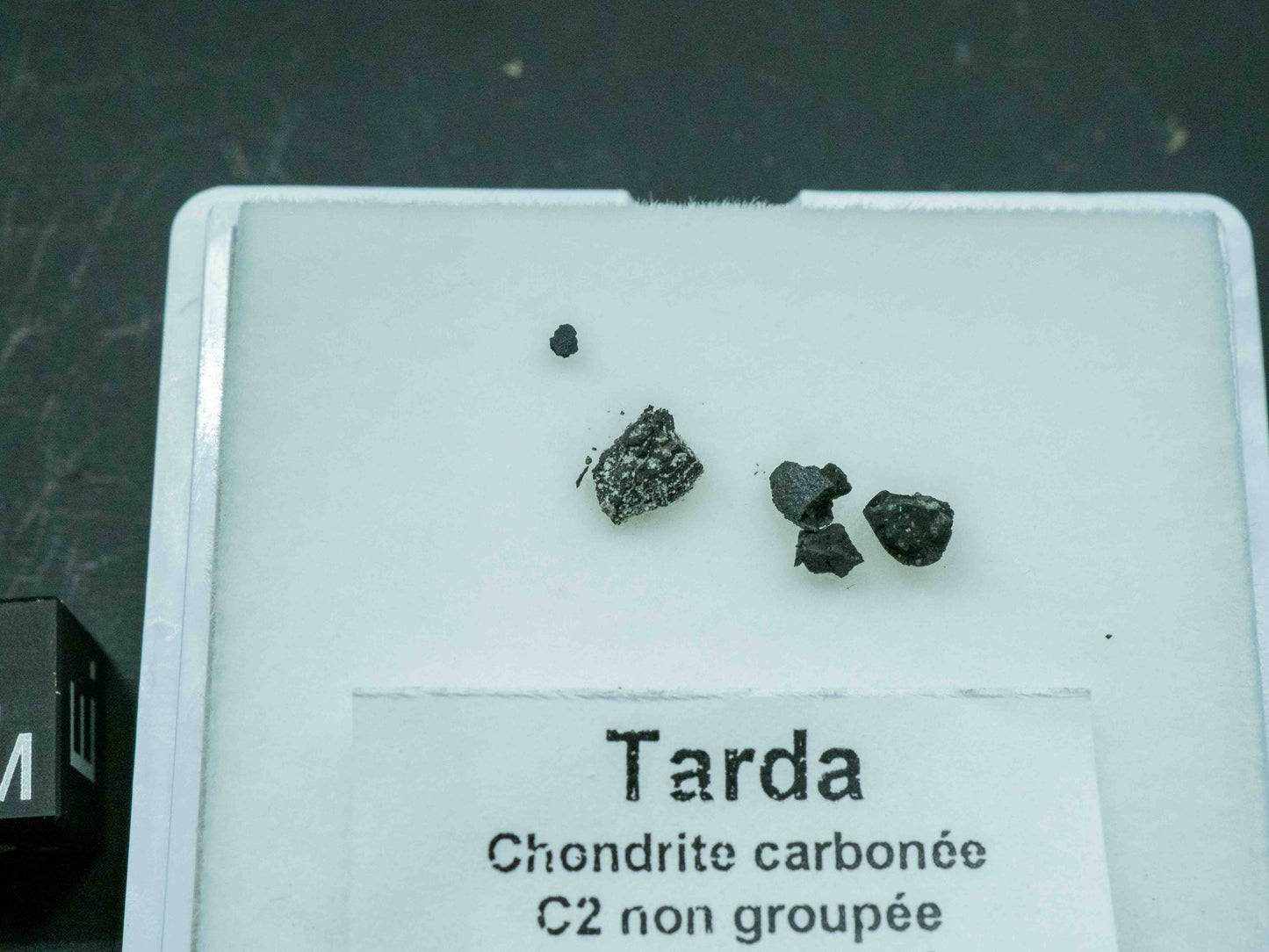
Tarda — C2 Ungrouped Carbonaceous Chondrite (0.10 grams)
Tarda — C2 Ungrouped Carbonaceous Chondrite (0.10 grams)
Couldn't load pickup availability
Tarda is a witnessed meteorite fall — one of only a small number of carbonaceous chondrite falls ever recovered on Earth. On August 25, 2020, a fireball tracking southwest to northeast lit up the skies over Alnif, Zagora, Tazarine, and Rich in southern Morocco. Local residents began searching within hours, and the first fragment was found the next day near the village that gave the meteorite its name.
Laboratory analysis — including oxygen isotope work — placed Tarda in its own category: an ungrouped C2 carbonaceous chondrite, chemically and spectrally similar to the famous Tagish Lake meteorite, and linked to primitive, water- and organic-rich D-type asteroids far out in the solar system. With roughly 8.5% water bound into its clay-rich matrix and evidence of significant aqueous alteration on its parent body, Tarda is considered scientifically important material for understanding the outer solar system bodies that upcoming missions like NASA's Lucy will study directly.
Tarda is notoriously fragile — the stones are friable and readily slake apart on contact with moisture, meaning intact, well-formed fragments like this one are increasingly hard to source as the total known weight (roughly 4 kg) is slowly consumed.
Classification: Carbonaceous chondrite, C2-ungrouped
Fell: August 25, 2020, near Tarda, Errachidia Province, Morocco — witnessed fall
Type: Primitive, hydrated chondrite, related to Tagish Lake