Rad Man Minerals
Uraninite & Native Silver — Eldorado Mine, Port Radium, Northwest Territories, Canada. Museum Cabinet Specimen
Uraninite & Native Silver — Eldorado Mine, Port Radium, Northwest Territories, Canada. Museum Cabinet Specimen
Couldn't load pickup availability
The Eldorado Mine at Port Radium on the eastern shore of Great Bear Lake is one of the most consequential uranium localities in history. When Gilbert LaBine staked the discovery claims in 1930, he touched off a radium rush that would ultimately feed the Allied nuclear program and define Canada's place in the atomic age. The ore bodies he found were unlike almost anything else on the continent — rich five-element veins carrying native silver, uraninite, cobalt, nickel, and bismuth in a mineralogical complexity that still commands the attention of serious collectors nearly a century later.
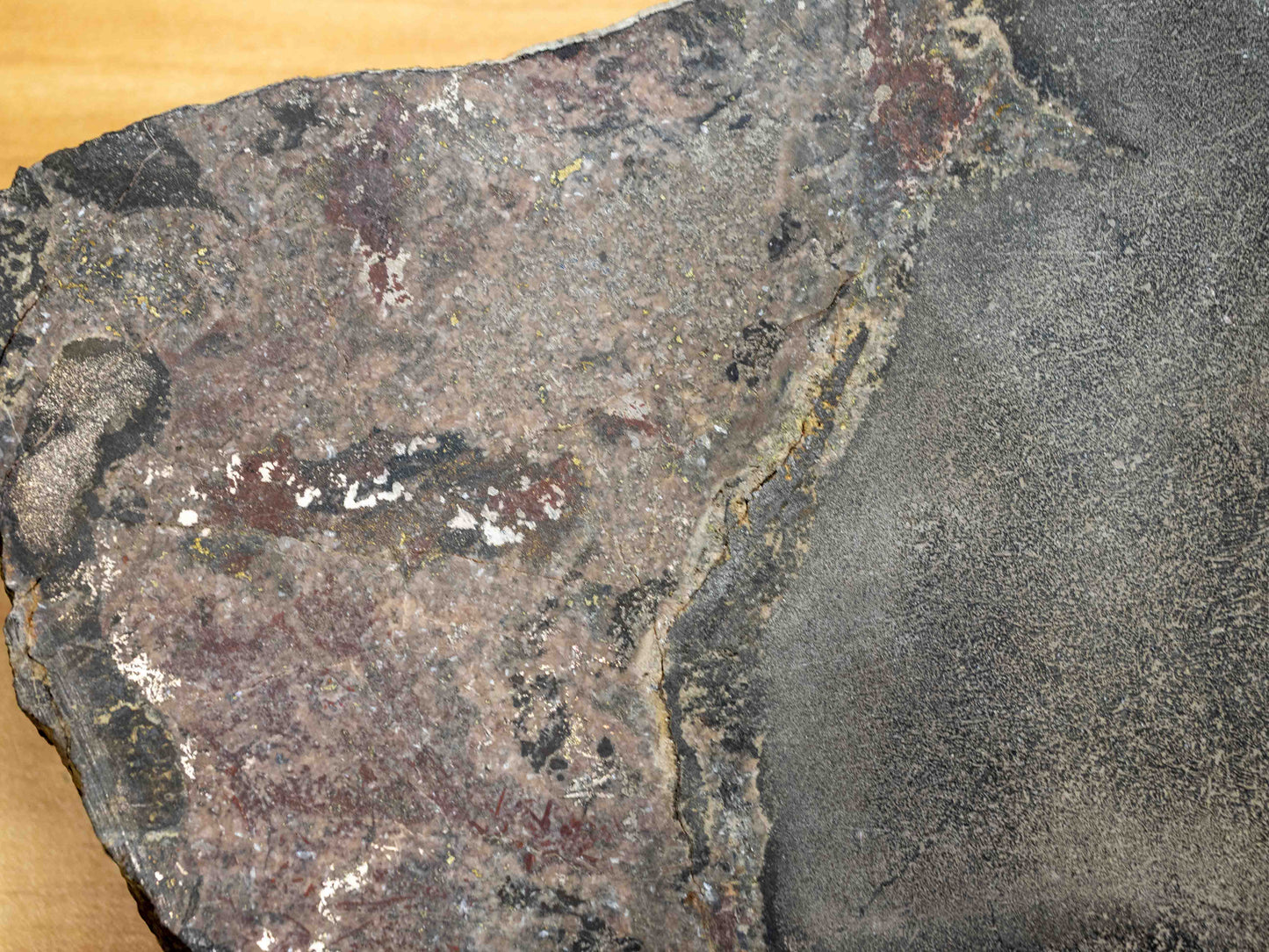
This is a large, cut cabinet slab from that deposit — the kind of piece that commands a room.
The cut face is dominated by dense, pitch-black uraninite with the characteristic heavy, resinous-to-submetallic lustre that distinguishes well-developed pitchblende from lesser uranium occurrences. The sheer mass and depth of colour is immediately arresting; this is not a specimen that requires explanation to impress. A bold pale gangue vein — calcite or carbonate matrix consistent with the Port Radium host rock — cuts across the left edge, providing sharp tonal contrast and framing the dark uraninite mass beautifully.
The right half of the slab tells a more complex mineralogical story. Earthy ochre and brown oxidation zones give way to areas of deep crimson and russet — phases consistent with the secondary alteration assemblage expected from a high-silver, uranium-rich vein system of this age and chemistry. Fine reddish dendritic and acicular forms are visible within the matrix; at Port Radium, material of this character is associated with native silver in wire, hair, and arborescent habits threading through the uraninite. Silver content at this locality was historically significant enough to be a co-product of mining operations, and it is present here in a visually compelling form.
These slabs originated from stones that passed through the collection of the Royal Ontario Museum in Toronto — among the most significant geological institutions in the country — before entering private hands. Material with that kind of lineage and from this specific locality does not come to market often. The combination of historical weight, mineralogical complexity, visual impact, and sheer cabinet size places this firmly outside the realm of typical collector offerings.
For the advanced collector. Not a beginner piece. Handling precautions appropriate to uraninite apply.
This is the largest slab I have in my collection. Once one or two of these slabs sell, I will be taking down the others to keep in my collection. This is great opportunity to obtain an extremely rare piece of Canadian mining history.
Approx. specimen size: 190mm x 150mm x 50mm
Approx. specimen weight: 4474 grams (4.474 kilograms)
Approx. specimen activity on an SE International Ranger EXP: 12000 CPM